Littel et al. (2023)
Microplate Evolution in the Queen Charlotte Triple Junction & Explorer Region: New Insights From Microseismicity
G. F. Littel, M. G. Bostock, A. Schaeffer, S. Roecker

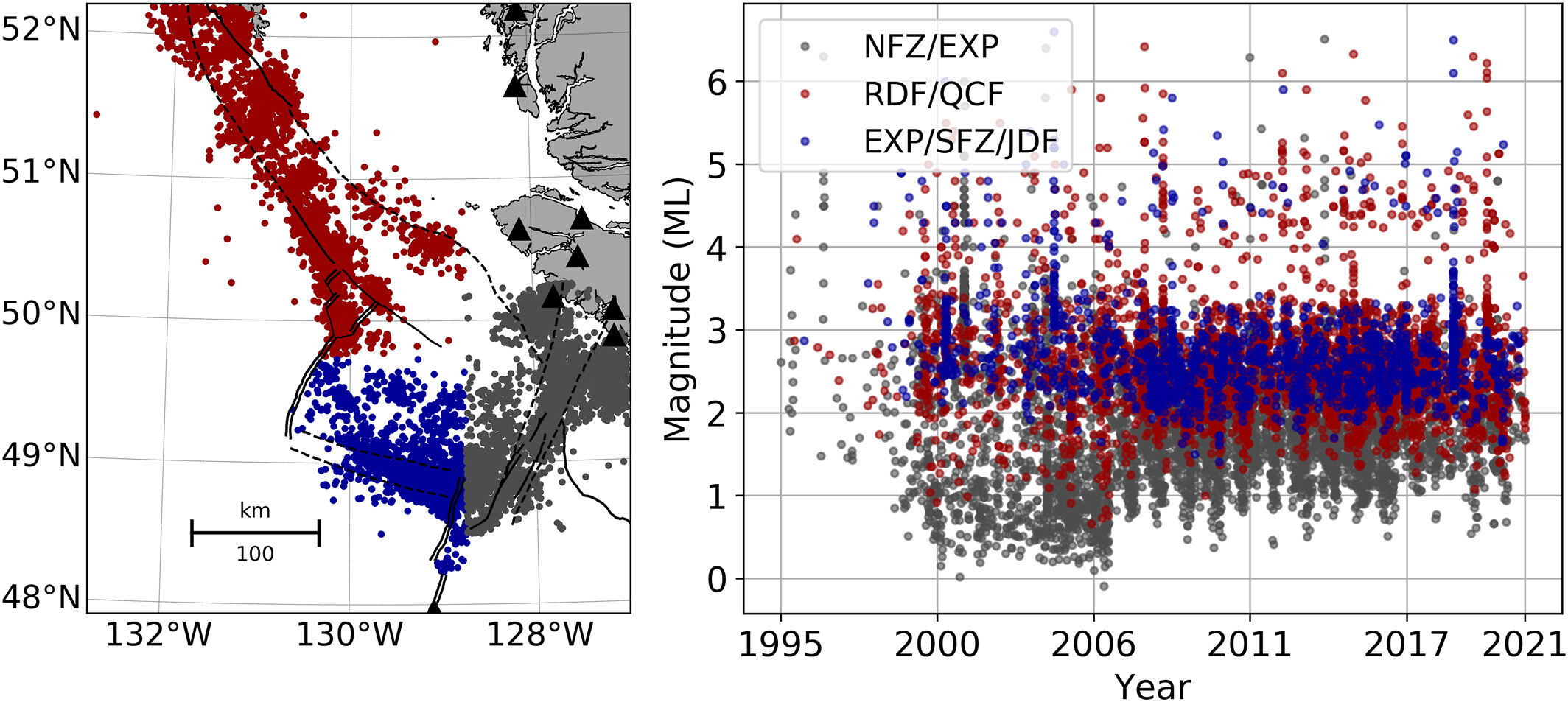
Figure 1:Local magnitudes determined by the GSC for the GSC catalog, divided into three subregions of the study area. Events included have at least 4 paired P and S phase picks.
Summary
The Queen Charlotte triple junction/Explorer microplate region offshore British Columbia, Canada, is marked by poorly understood and rapidly evolving microplate tectonics. Although the region hosts abundant seismicity, it has received relatively scant attention in recent years due to its remote, offshore location. We use the Regressive ESTimator (REST) algorithm to generate a new catalog of automatically detected earthquakes from 1995 to 2021, which, when merged with the existing Geological Survey of Canada catalog, yields the most extensive seismicity data set offshore British Columbia to date. We apply double-difference relocation to these events and perform stress inversions using moment tensors for subregions within the study area. Our results confirm and extend previous models of microplate deformation processes. We suggest the Revere-Dellwood-Queen Charlotte fault system has evolved as a NW-migrating, pull-apart system between Haida Gwaii and the Explorer ridge that obeys global length/width scaling and whose bathymetric expression is influenced by volcanism plausibly induced by interaction with the Kodiak-Bowie hotspot. Seismicity within the Explorer microplate is dominated by prominent, northeast-trending lineations that emanate from the Sovanco fracture zone and parallel the Nootka fault zone. Alignment of these features with spreading structures that bound the microplate suggests that its breakup is controlled primarily by a strength fabric inherited at spreading ridges. Stress inversions are dominated by near-vertical intermediate compressive stress reflecting the dominance of strike-slip faulting. Stress varies systematically between transpression to the north along southern Haida Gwaii and seafloor spreading to the south along the Juan de Fuca ridge.
Catalog Summary
REGION: Queen Charlotte Triple Junction
TIME SPAN: 1995-April 2021
EVENT TYPE: Tectonic Earthquakes
NUMBER OF EVENTS: 18,441 earthquakes
DETECTION METHOD: REST
ASSOCIATION METHOD: REST
LOCATION METHOD: HypoInverse+HypoDD
VELOCITY MODEL: Waldron (2010) + variable Vp/Vs
MAGNITUTE TYPE: N/A
- Littel, G. F., Bostock, M. G., Schaeffer, A., & Roecker, S. (2023). Microplate Evolution in the Queen Charlotte Triple Junction & Explorer Region: New Insights From Microseismicity. Tectonics, 42(6). 10.1029/2022tc007494
- Waldron, D. A. (2010). Structural characteristics of a subducting oceanic plate off Western Canada. 10.14288/1.0052985