Shelly et al. (2025)
A Northeast-Dipping Zone of Low-Frequency Earthquakes at the Southern Edge of Cascadia Subduction
D. R. Shelly, D. E. Goldberg, A. G. Wech, A. M. Thomas

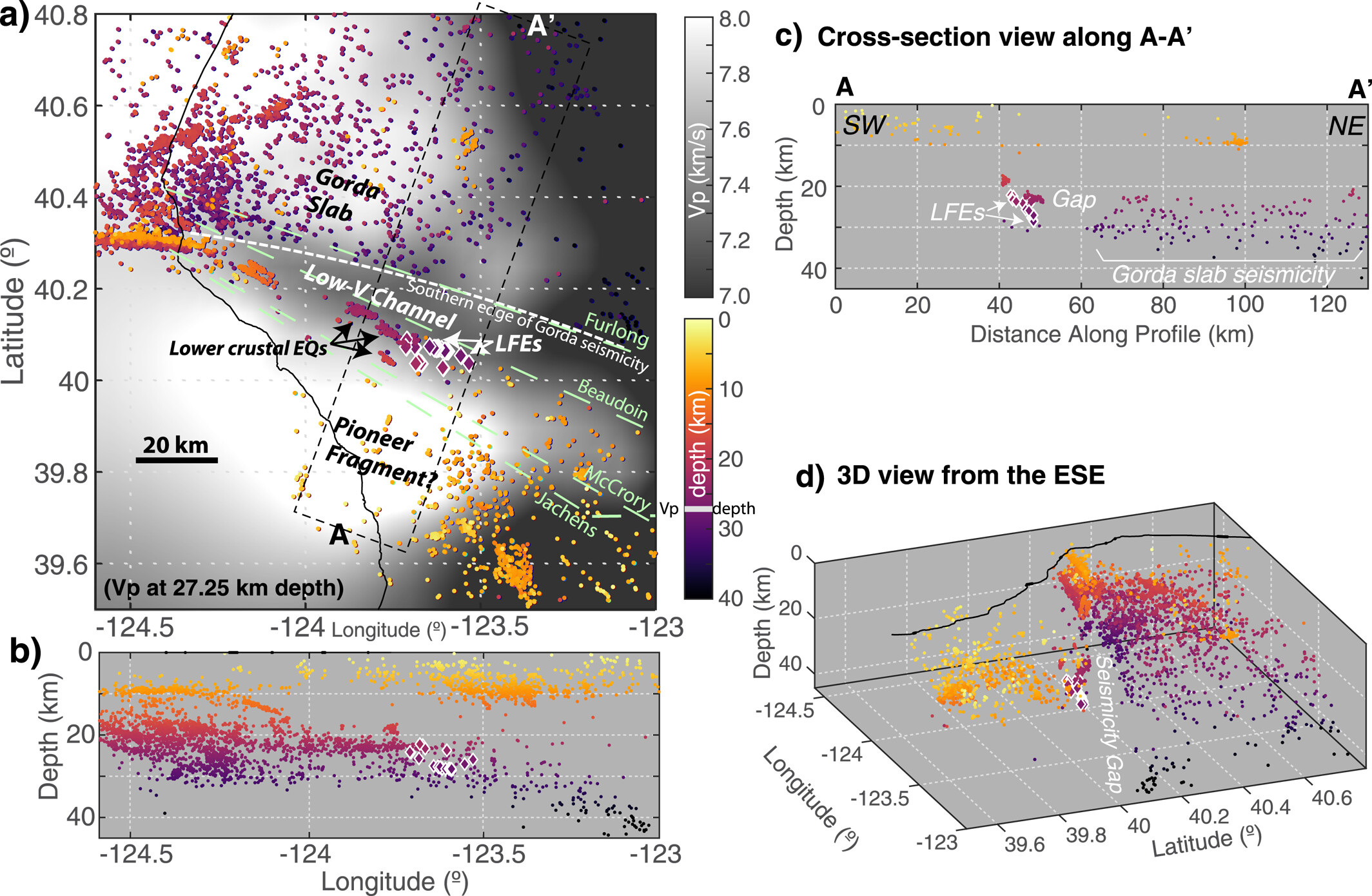
Figure 1:Relocated low-frequency earthquake (LFE) families and microseismicity. Microseismicity is from 01 January 2015 to 11 October 2024 (see Methods). LFEs are shown by white-outlined diamonds. Other seismicity shown by dots, color-coded by depth. Bold black line indicates the coastline. (a) Map view. Dashed box A-A’ indicates the area of the cross section plotted in part (c). P-wave velocity (Vp) depth slice at 27.25 km depth (near the mean LFE depth) from Furlong et al. (2024). Note that LFEs and microseismicity occur along a pronounced velocity contrast, tracking the southern boundary of the low-velocity (low-V) channel. Previously proposed edges of the Gorda slab are shown by light green dashed lines, labeled (from north to south) as Furlong (Furlong et al., 2024), Beaudoin (Beaudoin et al., 1998), McCrory (McCrory et al., 2006), and Jachens (Jachens & Griscom, 1983). The interpreted southern edge of Gorda slab seismicity is indicated by the slightly curved white dotted line. Velocity scale is truncated to emphasize relevant features. (b) West-east cross section, showing all events. (c) Cross section view along the line A-A (oriented along an azimuth of 20°), showing the dipping alignment of LFEs on the eastern edge of a zone of microseismicity. Seismicity is plotted from within the 30-km-wide dashed box in panel (a). (d) Three-dimensional view from the east-southeast (from azimuth 112° and elevation 22°), showing the gap in seismicity between LFEs and Gorda slab seismicity to the north.
Summary
Tectonic tremor monitoring occasionally detects events in an anomalous zone in southern Cascadia, 50–100 km west of the main tremor band, near the expected southern edge of the subducting Gorda slab at the Mendocino triple junction. To investigate the geometry and temporal behavior of this tremor, we examine its constituent low-frequency earthquakes (LFEs) by developing 27 stacked LFE waveform templates that we use to detect events from 2018 to 2024. We then relocate LFE sources together with regional seismicity. We find that LFE hypocenters form a northeast-dipping alignment at 22–29 km depth, extending eastward from a zone of micro-earthquakes, ∼15 km south of the southern edge of Gorda slab seismicity. These LFE families exhibit small bursts of activity every few days. Considering the strong world-wide association of tremor and LFEs with high slip-rate, plate-bounding faults, we hypothesize these LFEs may demark the southern edge of Cascadia subduction.
Catalog Summary
REGION: Mendocino Triple Junction
TIME SPAN: 2018-2024
EVENT TYPE: Low-frequency Earthquakes
NUMBER OF EVENTS: 61,441
DETCTION METHOD: Template Matching
ASSOCIATION METHOD: Template Matching
LOCATION METHOD: HypoInverse + HypoDD
VELOCITY MODEL: Yoon & Shelly (2024)
MAGNITUDE TYPE: N/A
- Shelly, D. R., Goldberg, D. E., Wech, A. G., & Thomas, A. M. (2025). A Northeast‐Dipping Zone of Low‐Frequency Earthquakes at the Southern Edge of Cascadia Subduction. Geophysical Research Letters, 52(12). 10.1029/2025gl116116
- Yoon, C. E., & Shelly, D. R. (2024). Distinct Yet Adjacent Earthquake Sequences near the Mendocino Triple Junction: 20 December 2021 Mw 6.1 and 6.0 Petrolia, and 20 December 2022 Mw 6.4 Ferndale. The Seismic Record, 4(1), 81–92. 10.1785/0320230053