Morton et al. (2023)
Cascadia Subduction Zone Fault Heterogeneities From Newly Detected Small Magnitude Earthquakes
E. A. Morton, S. L. Bilek, C. A. Rowe

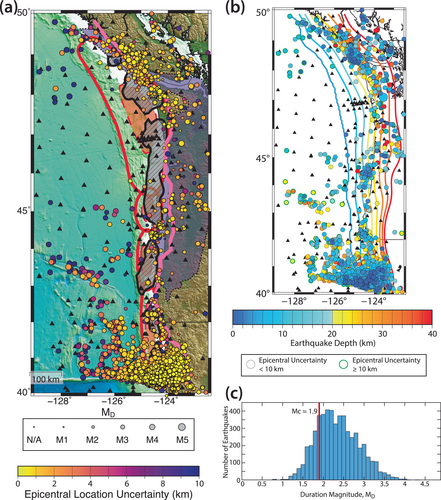
Figure 1:Caption: Map of 5,282 detected events. (a) Resulting catalog is shown sized by duration magnitude and colored by epicentral location uncertainty. Red outlined regions are high-moment release patches modeled for the 1700 M9 earthquake, constrained by coastal subsidence values (P. L. Wang et al., 2013). The shaded red regions inside these are patches where the 1700 model predicted 10m of slip or greater. Gray-shaded areas mark the position of forearc basins, indicated by gravity lows and possibly indicating interface asperities (Wells et al., 2003). The purple-shaded region corresponds to the presence of the Siletz terrane at the base of the overriding plate (Watt & Brothers, 2021). Pink line is the downdip 20% locked contour of the Gaussian model of Schmalzle et al. (2014). (b) Resulting catalog is shown colored by depth with the depth contours of the Slab2 model (Hayes et al., 2018). Outlines of events are colored by epicentral uncertainty greater than or less than 10 km. (c) Histogram of duration magnitudes of the resulting catalog, with magnitude of completeness, Mc ≈ 1.9.
Summary
The Cascadia subduction zone (CSZ) is known to host M9 megathrust ruptures; however, no such event has occurred in historical observation. The distribution and characteristics of small- to moderate-sized earthquakes can be used to determine the behavior of the megathrust fault but are notably absent offshore the CSZ due to the distance from onshore seismometers. We use automated subspace detection coupled with an onshore-offshore seismic deployment to find small-magnitude earthquakes in the offshore seismogenic zone and analyze their locations in the context of interseismic locking and seismogenic zone extent. We detected and located 5,282 earthquakes, 4,096 of which had been previously undetected. We find that the downdip extent of the seismogenic zone as defined by interplate seismicity agrees with the 20% locking contour of the Schmalzle et al. (2014) geodetic model and extends deeper than predicted by previous thermal models. We cannot determine the updip extent of the seismogenic zone; this may be due to a lack of templates for detection in the updip source area, stress shadows updip of asperity loading, and/or strong locking to the trench. We present a map of possible asperities determined by the small earthquakes in this study. Our asperity locations and extents show some, but not complete, agreement with the asperities modeled from the 1700 M9 rupture and geodetic locking models, and good agreement with the paleo-rupture extents determined from offshore turbidites and forearc basin-based asperity estimates. This highlights the need of continued offshore observations over time, and to elucidate fine-scale variation in locking.
Catalog Summary
REGION: Cascadia Subduction Zone
TIME SPAN: 2011-2015
EVENT TYPE: Tectonic Earthquakes
NUMBER OF EVENTS: 5,282 earthquakes
DETECTION METHOD: Subspace detection
ASSOCIATION METHOD: Subspace detection
LOCATION METHOD: HypoInverse
VELOCITY MODEL: Combined 1D models
MAGNITUDE TYPE: Md
- Morton, E. A., Bilek, S. L., & Rowe, C. A. (2023). Cascadia Subduction Zone Fault Heterogeneities From Newly Detected Small Magnitude Earthquakes. Journal of Geophysical Research: Solid Earth, 128(6). 10.1029/2023jb026607
- Schmalzle, G. M., McCaffrey, R., & Creager, K. C. (2014). Central Cascadia subduction zone creep. Geochemistry, Geophysics, Geosystems, 15(4), 1515–1532. 10.1002/2013gc005172