Bostock et al. (2015)
Magnitudes and moment-duration scaling of low-frequency earthquakes beneath southern Vancouver Island
M. G. Bostock, A. M. Thomas, G. Savard, L. Chuang, A. M. Rubin

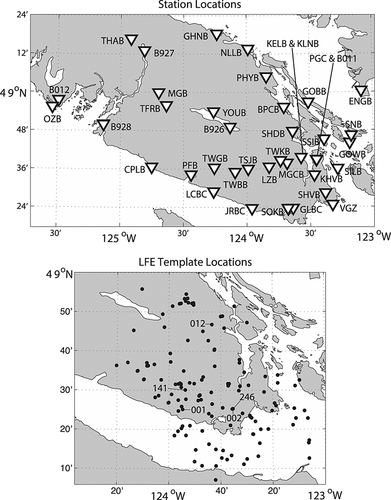
Figure 1:(top) Map of stations and (bottom) LFE template locations employed in this study. Templates referred to in text are identified by number in Figure 1 (bottom).
Summary
We employ 130 low-frequency earthquake (LFE) templates representing tremor sources on the plate boundary below southern Vancouver Island to examine LFE magnitudes. Each template is assembled from hundreds to thousands of individual LFEs, representing over 269,000 independent detections from major episodic-tremor-and-slip (ETS) events between 2003 and 2013. Template displacement waveforms for direct P and S waves at near epicentral distances are remarkably simple at many stations, approaching the zero-phase, single pulse expected for a point dislocation source in a homogeneous medium. High spatiotemporal precision of template match-filtered detections facilitates precise alignment of individual LFE detections and analysis of waveforms. Upon correction for 1-D geometrical spreading, attenuation, free surface magnification and radiation pattern, we solve a large, sparse linear system for 3-D path corrections and LFE magnitudes for all detections corresponding to a single-ETS template. The spatiotemporal distribution of magnitudes indicates that typically half the total moment release occurs within the first 12–24 h of LFE activity during an ETS episode when tidal sensitivity is low. The remainder is released in bursts over several days, particularly as spatially extensive rapid tremor reversals (RTRs), during which tidal sensitivity is high. RTRs are characterized by large-magnitude LFEs and are most strongly expressed in the updip portions of the ETS transition zone and less organized at downdip levels. LFE magnitude-frequency relations are better described by power law than exponential distributions although they exhibit very high b values ≥∼5. We examine LFE moment-duration scaling by generating templates using detections for limiting magnitude ranges (MW<1.5, MW≥2.0). LFE duration displays a weaker dependence upon moment than expected for self-similarity, suggesting that LFE asperities are limited in fault dimension and that moment variation is dominated by slip. This behavior implies that LFEs exhibit a scaling distinct from both large-scale slow earthquakes and regular seismicity.
Catalog Summary
REGION: Southern Vancouver Island
TIME SPAN: 2003-2013
EVENT TYPE: Low-frequency Earthquakes
NUMBER OF EVENTS: 269,424
DETECTION METHOD: Template Matching
ASSOCIATION METHOD: Template Matching
LOCATION METHOD: Hyp2000
VELOCITY MODEL: See Notes
MAGNITUDE TYPE: Mw
Notes
The 1D velocity model dates back to Nicholson et al. (2005) where it is again cited as coming from GSC as (Cassidy, personal communication). The Vp/Vs is set at sqrt(3). The Vp model is:
Vp (km/s) | Depth (km) |
|---|---|
5.00 | 0.00 |
6.00 | 1.00 |
6.70 | 6.00 |
7.10 | 30.00 |
7.75 | 45.00 |
- Bostock, M. G., Thomas, A. M., Savard, G., Chuang, L., & Rubin, A. M. (2015). Magnitudes and moment‐duration scaling of low‐frequency earthquakes beneath southern Vancouver Island. Journal of Geophysical Research: Solid Earth, 120(9), 6329–6350. 10.1002/2015jb012195
- Nicholson, T., Bostock, M., & Cassidy, J. F. (2005). New constraints on subduction zone structure in northern Cascadia. Geophysical Journal International, 161(3), 849–859. 10.1111/j.1365-246x.2005.02605.x