Wech (2021)
Cataloging Tectonic Tremor Energy Radiation in the Cascadia Subduction Zone
A. G. Wech

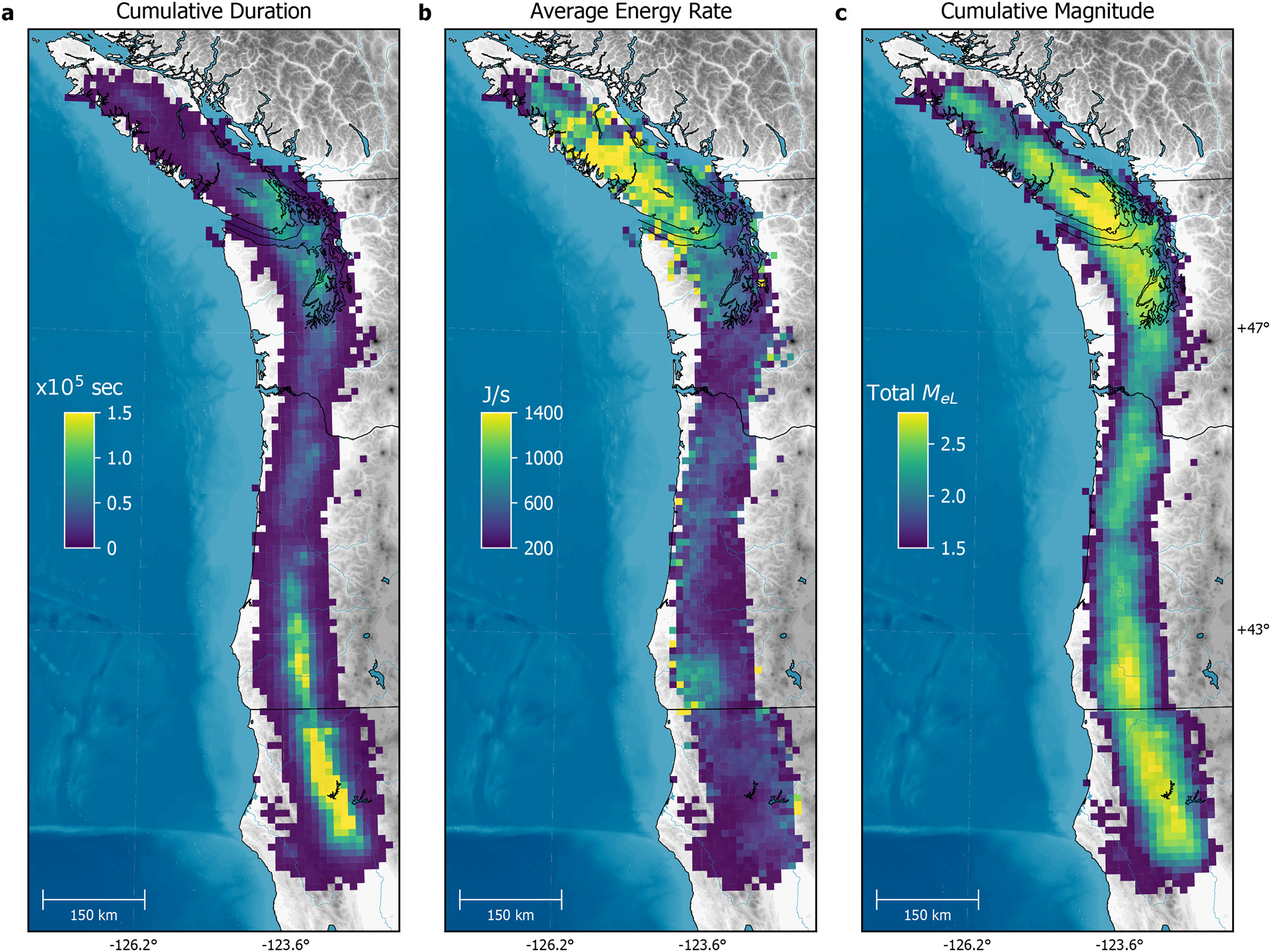
Figure 1:(a) Map of total tremor duration, (b) average tremor energy rate, and (c) cumulative magnitude for the entire tremor catalog in 10 × 10 km bins.
Summary
For the past ∼12 years the Pacific Northwest Seismic Network has been automatically detecting and locating tectonic tremor across the Cascadia subduction zone, resulting in a catalog of more than 500,000 tremor epicenters to date, which has served as a valuable resource for tremor and slip research. This manuscript presents an updated methodology for routine tremor detection in Cascadia and a new catalog of over 180,000 tremor epicenters including amplitudes detected along the subduction zone margin from 2017 to 2021. The events are detected via cross-correlation of continuous vertical envelope data of 128 stations from northern California to northern Vancouver Island. The modified approach results in less scatter and a 55% increase in detected epicenters than previously observed, as well as a newly identified tremor source offset updip from the main tremor and slip region at the southern edge of the subduction zone. Radiated seismic energy in the 1.5–5 Hz band is used to assign epicenters an energy magnitude (MeL), which is calibrated to the ML of local earthquakes. Southern Cascadia is most active, but the highest tremor energy rates occur in northern Cascadia. Tremor in central Cascadia is systematically weaker and less frequent. Individual epicenter magnitudes range from ∼0.5–2 and spatiotemporally cluster into 1,060 swarms with cumulative MeL ranging from ∼0.8 to 3.7. The swarms reflect underlying slow slip events and occur with an earthquake-like energy distribution with a b value ∼1. Tremor epicenters, however, follow a tapered Gutenberg-Richter distribution with high b values, suggesting individual tremor bursts and their constituent low-frequency earthquakes are fault-dimension limited.
Catalog Summary
REGION: Cascadia
TIME SPAN: 8/6/2009-12/31/2025
EVENT TYPE: Tremor
NUMBER OF EVENTS: 740,071 tremor
DETCTION METHOD: ENVELOC
ASSOCIATION METHOD: ENVELOC
LOCATION METHOD: ENVELOC
VELOCITY MODEL: Wech (2021)
MAGNITUDE TYPE: MeL
Notes
A static version of Wech (2021) tremor catalog is included in the Earthqake Catalog Repository. This catalog is updated and maintained by the Pacific Northwest Seismic Network.
- Wech, A. G. (2021). Cataloging Tectonic Tremor Energy Radiation in the Cascadia Subduction Zone. Journal of Geophysical Research: Solid Earth, 126(10). 10.1029/2021jb022523