Hirao et al. (2025)
Magmatic volatile flux drives non-eruptive volcano-tectonic seismicity at Mount St. Helens, USA from 2008-2023
B. Hirao, A. M. Thomas, D. R. Shelly, W. A. Thelen, and C. R. Journeau

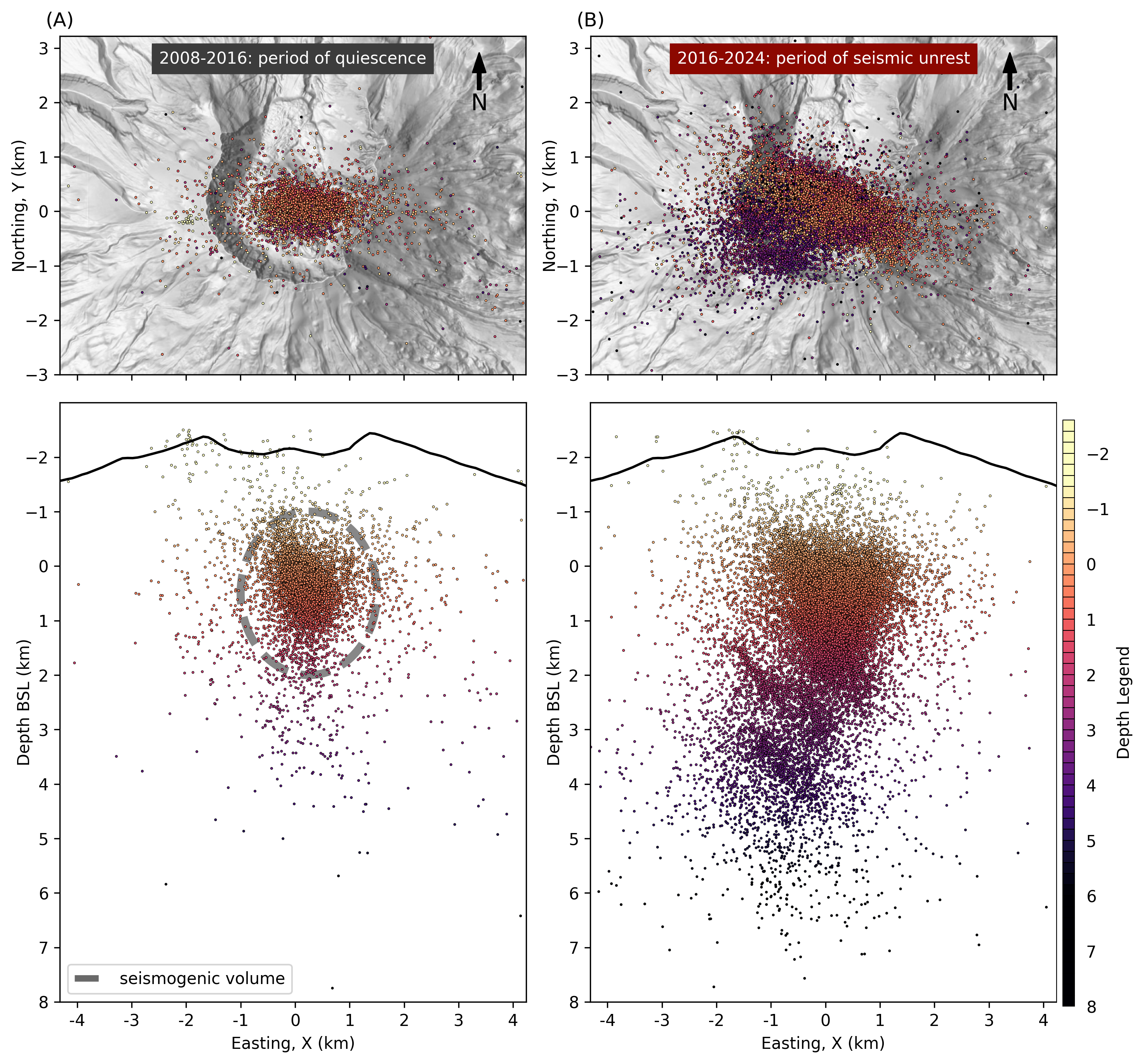
Figure 1:Map and depth sections of seismicity within the periods (A) 2008 to 2016 and (B) 2016 to 2024.
Summary
Seismicity during non-eruptive periods is useful for observing stress changes related to magmatic transport and volatile exsolution within active volcanoes. Mount St. Helens in Washington, USA, is the most active volcano in the continental United States and has been in quiescence since 2008. To explore the processes driving seismicity at Mount St. Helens, we create a high-resolution seismicity catalog of non- eruptive seismicity from 2008 through 2023, consisting of 31,133 events. We find persistent shallow seismicity (-2.2 to 2 km below sea level (BSL), 0 to 4.2 km below the surface) throughout the entire study period that concentrates beneath the dacite dome complex from the 1980 –1986 and 2004 –2008 eruptions. Additionally, there is frequent deeper seismicity (2 to 8 km BSL, 4.2 to 12.2 km below the surface) beginning in 2016. We examine a selection of deep earthquake swarms and find complex along-depth seismicity patterns. Within swarms, increases in shallow seismicity rates can precede or are concurrent with increases of deep seismicity rates. Lastly, we discover a series of semi- periodic, shallow, burst-like swarms, consisting of low-amplitude, repetitive similar earthquakes, indicating periodic valve-like release of fluid pressure from the conduit. Increased seismic activity beginning in 2016 indicates ongoing repressurization within the magmatic system driven by recharge or crystallization-induced second boiling within the upper-crustal reservoir after 2008. The data indicate that non-eruptive seismicity at Mount St. Helens is controlled by fluid pressure changes from gas flux sourced from the magma reservoir that migrates through crack networks.
Catalog Summary
REGION: Mt. St. Helens
TIME SPAN: 2008-2023
EVENT TYPE: Volcanic Earthquakes
NUMBER OF EVENTS: 31,133 earthquakes
DETECTION METHOD: Template Matching
ASSOCIATION METHOD: Template Matching
LOCATION METHOD: HypoDD+GrowClust
VELOCITY MODEL: Kiser et al. (2019) + Vp/Vs=1.65
MAGNITUTE TYPE: ML (See Notes)
Notes
Magnitudes are best characterized as ML but also include relative amplitude corrections.
- Hirao, B. W., Thomas, A. M., Shelly, D. R., Thelen, W. A., & Journeau, C. (2025). Magmatic Volatile Flux Drives Non‐Eruptive Volcano‐Tectonic Seismicity at Mount St. Helens, USA From 2008–2024. Journal of Geophysical Research: Solid Earth, 130(12). 10.1029/2025jb031278
- Kiser, E., Levander, A., Zelt, C., Schmandt, B., & Hansen, S. (2019). Upper Crustal Structure and Magmatism in Southwest Washington: Vp, Vs, and Vp/Vs Results From the iMUSH Active‐Source Seismic Experiment. Journal of Geophysical Research: Solid Earth, 124(7), 7067–7080. 10.1029/2018jb016203