He et al. (2026)
The CRESCENT Generation 0 Cascadia Community Velocity Model: Constraints From the Joint Inversion of Teleseismic Receiver Functions and Ambient Noise Data
Bin He, Jonathan R. Delph, Shihan Wu, Emilie E. E. Hooft, Alex Grant, Valerie J. Sahakian, Pieter-Ewald Share, William J. Stephenson, Erin A. Wirth, Brandon Herr, Ross Maguire, Guoliang Li, Rasheed Ajala

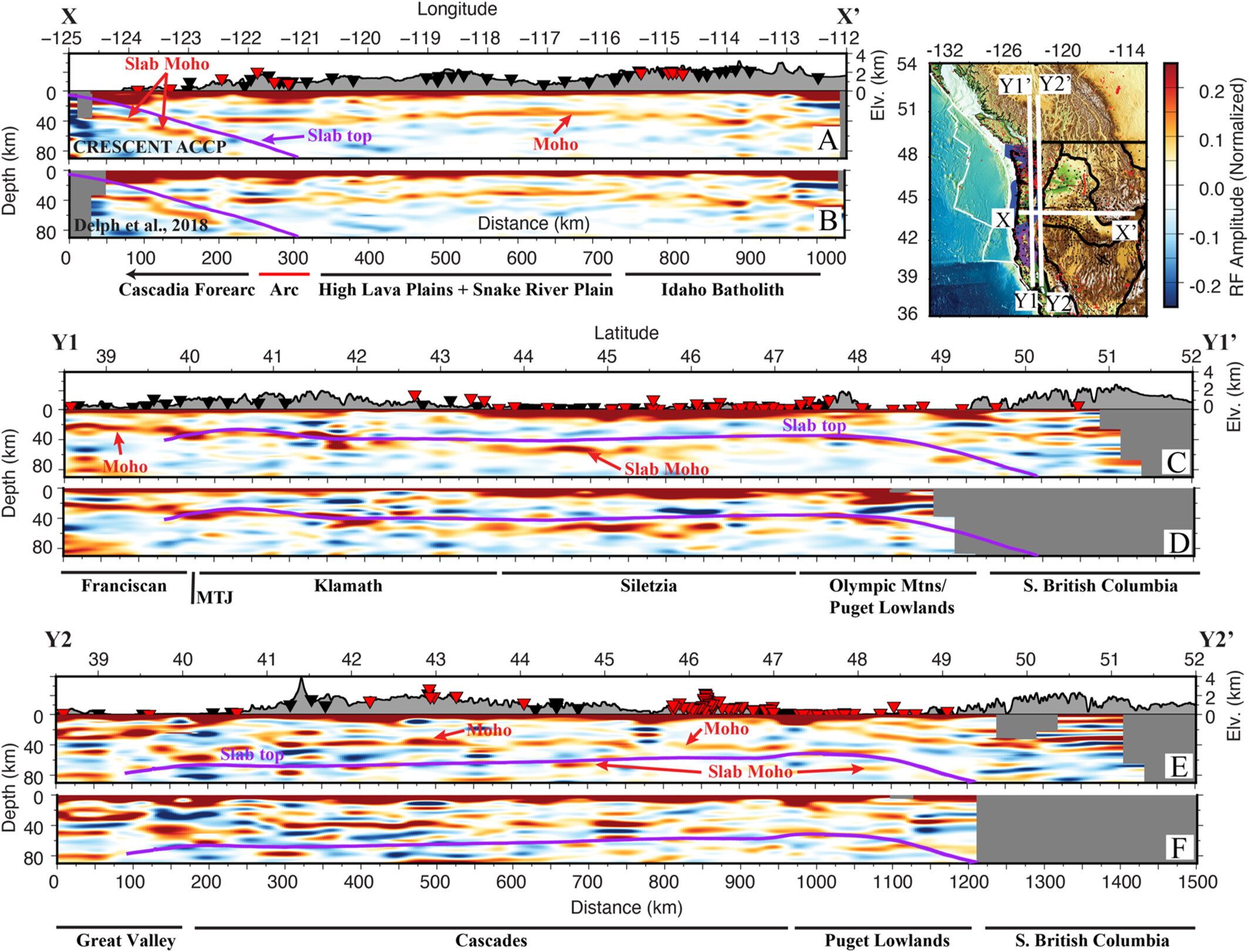
Figure 1:Adaptive Common Conversion Point (ACCP) stacking results from this study (panels a, c, and e) are compared with those from Delph et al. (2018) (panels b, d, and f), corresponding to cross-sections X–X′ along 44.1° N (a, b), Y1–Y1′ along −132.2° W (c, d), and Y2-Y2′ along −122.2° W (e, f). In each panel, surface topography is shown at the top and shaded in gray. Red triangles denote newly added stations and/or data that were not used in Delph et al. (2018), where black triangles denote previously used stations/data. The slab contour from McCrory et al. (2012) is plotted as a solid purple line. Profile locations are indicated by white lines in the top-right inset map, which also includes the color scale used for the ACCP profiles.
Summary
The Cascadia subduction zone can produce M9+ megathrust and M6.5+ intraplate earthquakes, motivating the need for a detailed 3-D model of seismic properties at scales relevant to regional geology, basins, and infrastructure. To construct the Generation 0 Cascadia Region Earthquake Science Center Community Velocity Model (CRESCENT CVM), we jointly invert ∼20 years of teleseismic P-wave radial receiver functions and 6–50 s Rayleigh-wave phase velocities from ambient-noise correlations recorded by ∼2,300 onshore and offshore stations. Using a Bayesian framework, we build a pseudo-3-D shear-wave velocity model with associated uncertainties. The model spans central California to southern British Columbia (∼36 to 52°N) and the Juan de Fuca–Pacific Plate boundary to eastern limit of major neotectonic deformation (∼131 to 111° W), with major boundaries resolved at ∼20 km laterally. Our model recovers previously observed slow velocities of the Franciscan terrane, Central Valley, and Yakima Basin juxtaposed with fast velocities of Klamath and Siletzia terranes, Sierra Nevada Batholith, and Ancestral Cascade Range at upper crustal depths (<10 km). At greater depth, we recover low-velocity zones in the lower crust beneath the Klamath terrane and Olympic Mountains, high-velocities extending to the base of the crust below the Siletzia terrane, and pervasive back-arc low velocity zones. Velocity uncertainties are largest at shallow depths (∼5 km) and near the crust-mantle transition - regions that could be the focus of improvement in future CVMs. This model can serve as a starting point for future models that incorporate full waveform inversion and higher frequency data sets to better constrain seismic hazard.
Model Information
SUMMARY: CRESCENT CVM Gen 0 was created from the joint inversion of ambient noise Rayleigh waves dispersion measurements (onshore and offshore) using FMST and adaptive CCP-derived receiver functions (onshore only)
MODEL TYPE: V, V, and density
MINIMUM LONGITUDE: -128.8
MAXIMUM LONGITUDE: -111.2
LONGITUDE RESOLUTION: 0.2
MINIMUM LATITUDE: 37
MAXIMUM LATITUDE: 49.6
LATITUDE RESOLUTION: 1
MINIMUM DEPTH: -3 km
MAXIMUM DEPTH: 100 km
- He, B., Delph, J. R., Wu, S., Hooft, E. E. E., Grant, A., Sahakian, V. J., Share, P., Stephenson, W. J., Wirth, E. A., Herr, B., Maguire, R., Li, G., & Ajala, R. (2026). The CRESCENT Generation 0 Cascadia Community Velocity Model: Constraints From the Joint Inversion of Teleseismic Receiver Functions and Ambient Noise Data. Journal of Geophysical Research: Solid Earth, 131(7). 10.1029/2025jb033216