Savard et al. (2018)
Seismicity, Metamorphism, and Fluid Evolution Across the Northern Cascadia Fore Arc
Geneviève Savard, Michael G. Bostock, and Nikolas I. Christensen

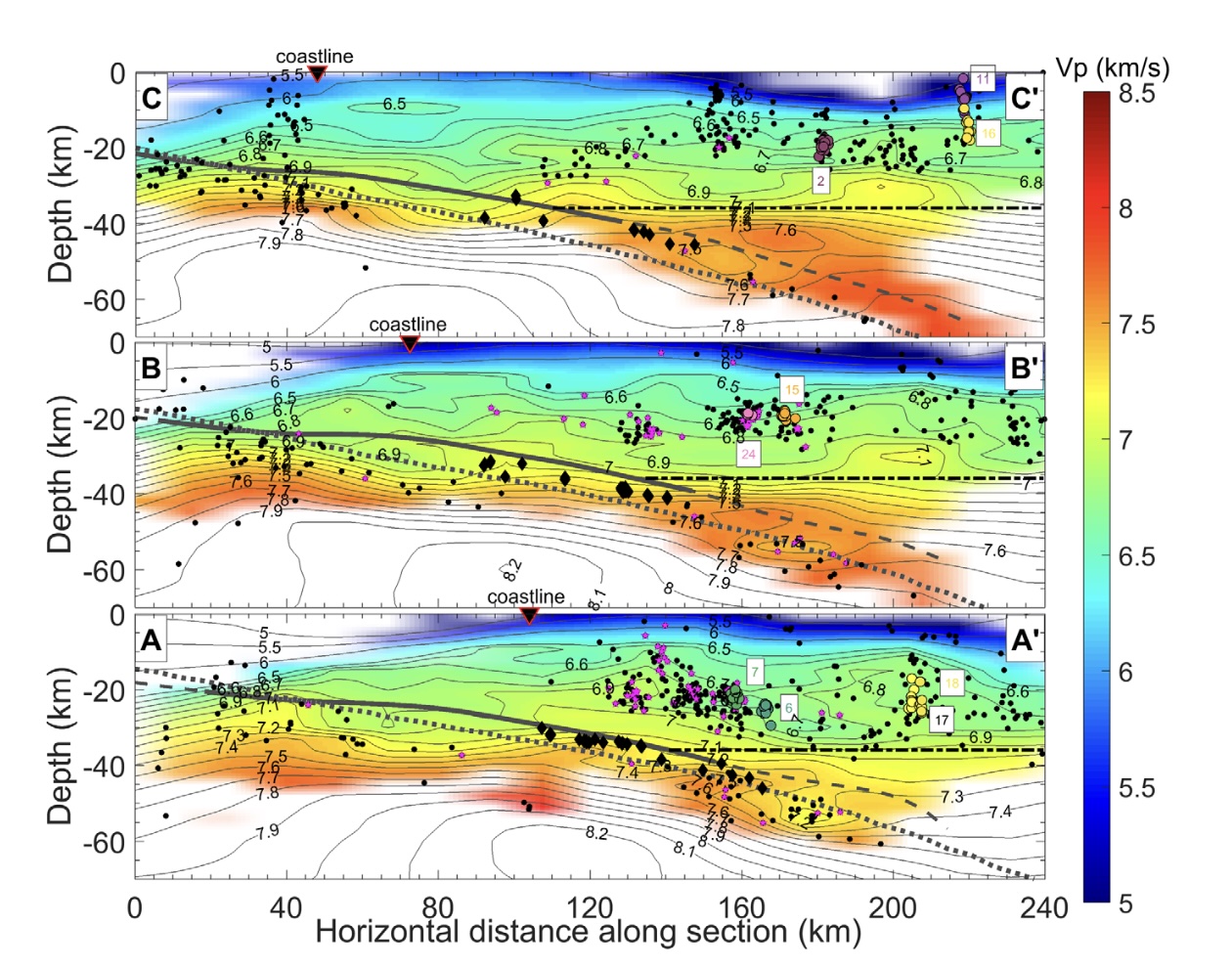
Figure 1:Model V along the sections AA’, BB’, and CC’. These profiles are taken parallel to the linear POLARIS array. Black diamonds are LFE hypocenters, black and pink dots are relocated earth- quakes within 10 km of the cross section, with pink dots identifying previously uncataloged earthquakes detected by the cross-station algorithm. The thick gray line is the plate interface model of Audet et al. (2010), and dashed gray line is the plate interface model of McCrory et al. (2012). The horizontal dash-dot line is the nominal Moho depth of 36 km. Inverted black triangle marks west Vancouver Island coastline.
Summary
We invert traveltime data from regular seismicity and low-frequency earthquakes (LFEs) on southern Vancouver Island to map fore-arc structure and seismogenesis. Tomographic images reveal high Poisson’s ratios associated with a previously mapped, dipping low-velocity zone inferred to be overpressured, upper oceanic crust of the Juan de Fuca plate, where LFEs and other slow-slip phenomena occur. Low Poisson’s ratios ( 0.225) in the fore-arc continental crust above the mantle wedge are accompanied by high V (6.65 km/s) and high levels of clustered microseismicity. This crustal anomaly is positioned above the slab, where focused expulsion of fluids is inferred based on independent evidence, suggesting an association between composition, fluids, and seismogenesis. We propose that the anomalous crust harbors a high percentage (15%) of quartz, characterized by extremely low Poisson’s ratio of 0.1. Earlier studies have proposed that excess quartz in the crust is precipitated from fluids fluxed from the subducting slab. In con trast, we posit that quartz is produced and concentrated in situ by metasomatism in the fore-arc crust catalyzed through focused ingress of slab-derived fluids at high-pore pressure. These fluids enable microseismic activation of high-angle thrust faults through a fault-valve mechanism that concentrates quartz via pore-pressure cycling. Larger M6 events like those recently proposed to occur along the Leech River Fault may nucleate deep in the brittle-ductile transition as a result of these reactions. The fore-arc crust in warm subduction settings may thus suffer extreme exposure to prolonged fluid flow, an inference with relevance to the genesis of orogenic gold deposits.
Model Information
SUMMARY: Double difference tomography from inversion of earthquake and low-frequency earthquake travel times on Southern Vancouver Island
MODEL TYPE: V, V, and density
MINIMUM LONGITUDE: -126
MAXIMUM LONGITUDE: -121.1
LONGITUDE RESOLUTION: 0.1
MINIMUM LATITUDE: 47
MAXIMUM LATITUDE: 50.9
LATITUDE RESOLUTION: 0.1
MINIMUM DEPTH: 0 km
MAXIMUM DEPTH: 93 km
- Savard, G., Bostock, M. G., & Christensen, N. I. (2018). Seismicity, Metamorphism, and Fluid Evolution Across the Northern Cascadia Fore Arc. Geochemistry, Geophysics, Geosystems, 19(6), 1881–1897. 10.1029/2017gc007417