Delph et al. (2018)
Fluid Controls on the Heterogeneous Seismic Characteristics of the Cascadia Margin
Jonathan R. Delph, Alan Levander, and Fenglin Niu

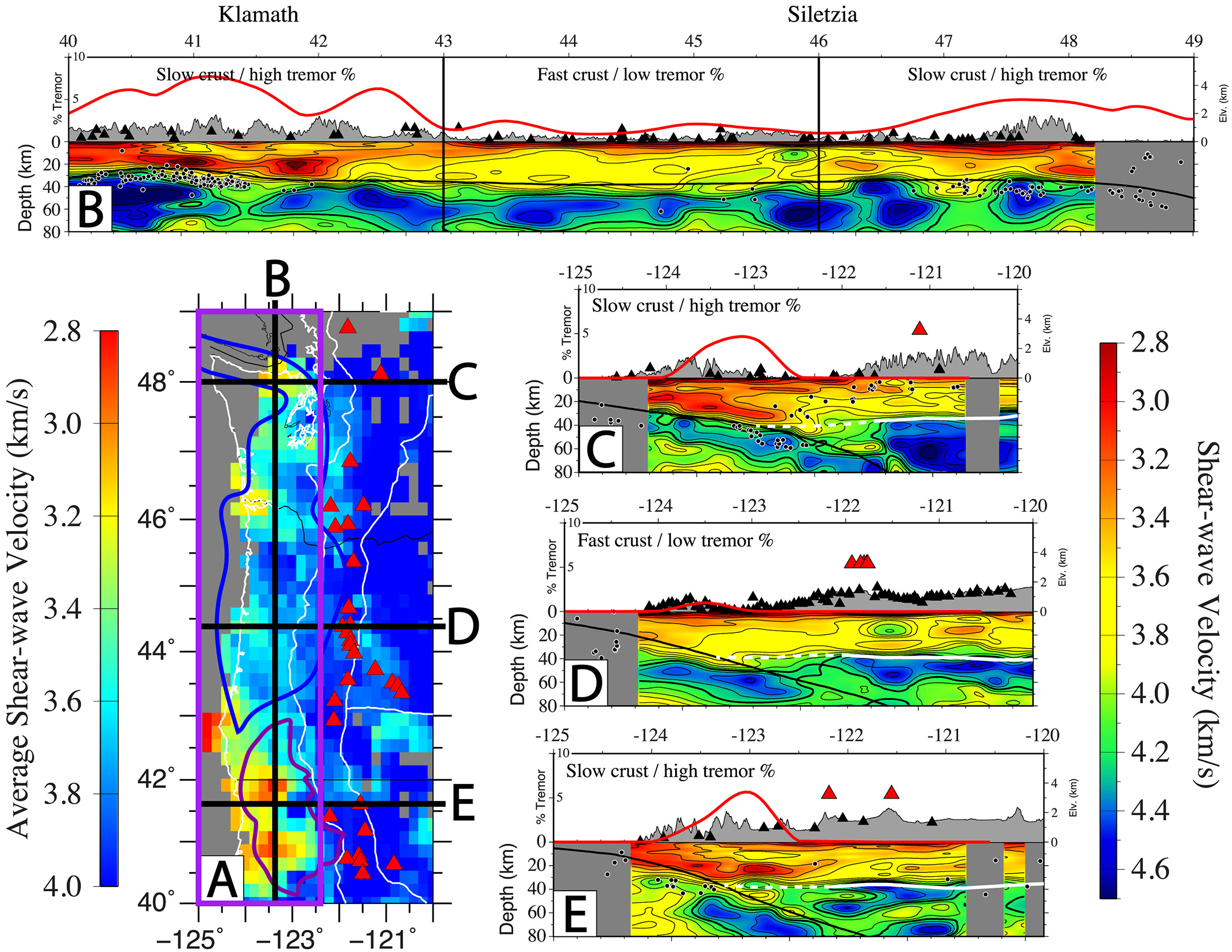
Figure 1:Shear wave velocity (Vs) structure of the Cascadian margin. (a) Average Vs in lower 10 km of the crust. Purple box: extent of areal average (Figure 3). Other symbols described in Figure 1. (b) Cross section along the Cascadia forearc (longitude: −123.4°). Black vertical lines: transition between Klamath (south), Siletzia (central), and Siletzia/Olympic Mountains (north). Lower crustal low-velocity zones (LVZs) beneath the northern and southern margin of the Cascadia forearc correlate with increased seismicity (black dots) and nonvolcanic tremor (NVT) density (red lines on topography; from Figure 1b). (c) Cross section along 48°N: LVZ parallels subducting plate (black line) and correlates with high NVT density. (d) Cross-section along 44.4°N. The Siletzia terrane shows little internal seismic variation, and tremor density is low. (e) Cross section along 41.6°N. LVZ and NVT correlation similar to that observed in the north. Black triangles: seismic stations (within 30 km of line). White line: estimated Moho depth; black line: slab surface (McCrory et al., 2012).
Summary
The dehydration of oceanic slabs during subduction is mainly thermally controlled and is often expressed as intermediate-depth seismicity. In warm subduction zones, shallow dehydration can also lead to the buildup of pore-fluid pressure near the plate interface, resulting in nonvolcanic tremor. Along the Cascadia margin, tremor density and intermediate-depth seismicity correlate but vary significantly from south to north despite little variation in the thermal structure of the Juan de Fuca Plate. Along the northern and southern Cascadia margin, intermediate-depth seismicity likely corresponds to increased fluid flux, while increased tremor density may result from fluid infiltration into thick underthrust metasediments characterized by very slow shear wave velocities (<3.2 km/s). In central Cascadia, low intermediate-depth seismicity and tremor density may indicate a lower fluid flux, and shear wave velocities indicate that the Siletzia terrane extends to the plate interface. These results indicate that the presence of thick underthrust sediments is associated with increased tremor occurrence.
Model Information
SUMMARY: Joint inversion of ambient noise Rayleigh wave phase dispersion measurements (8-50 seconds) and adaptive CCP-derived receiver functions
MODEL TYPE: V and Rayleigh wave phase dispersion
MINIMUM LONGITUDE: -124.8
MAXIMUM LONGITUDE: -120
LONGITUDE RESOLUTION: 0.2
MINIMUM LATITUDE: 40
MAXIMUM LATITUDE: 49
LATITUDE RESOLUTION: 1
MINIMUM DEPTH: -3 km
MAXIMUM DEPTH: 80 km
- Delph, J. R., Levander, A., & Niu, F. (2018). Fluid Controls on the Heterogeneous Seismic Characteristics of the Cascadia Margin. Geophysical Research Letters, 45(20). 10.1029/2018gl079518