Delph et al. (2021)
Subcretionary tectonics: Linking variability in the expression of subduction along the Cascadia forearc
Jonathan R. Delph, Amanda M. Thomas, and Alan Levander

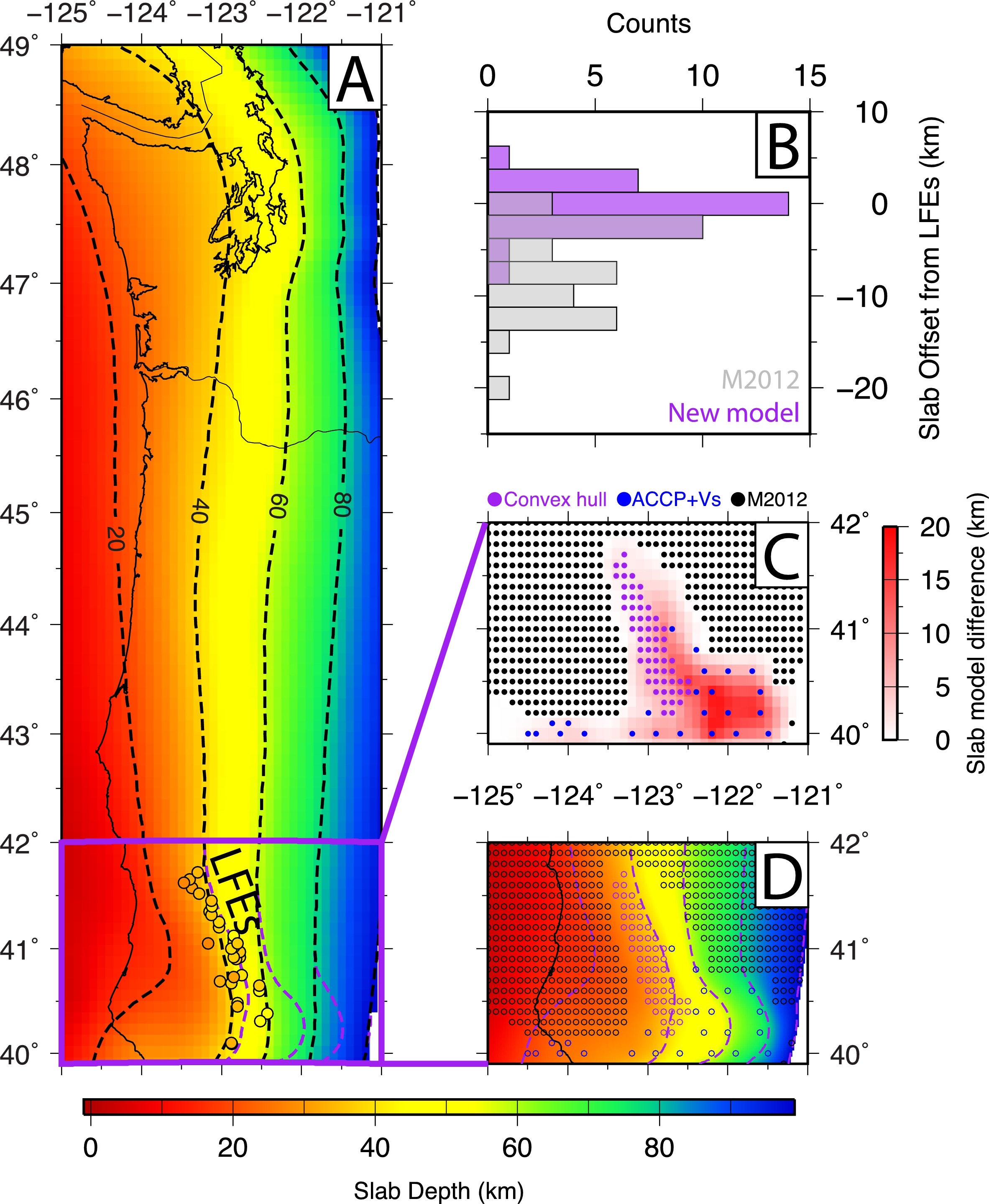
Figure 1:Comparison between slab models. (A) Model of McCrory et al. (2012) colored by depth. LFE locations shown by circles and colored by depth (Plourde et al., 2015). Contours every 20 km. Purple line: refined slab model from this study. (B) Histogram of differences between LFE locations and slab depth at their epicenter (gray, McCrory et al., 2012; purple, refined slab model). The M2012 model is often >5 km deeper than LFE hypocenters, while the modified slab model is in much better agreement with LFEs. (C) Modification to the M2012 model (black dots) using a surface created with a 3rd order polynomial fit constrained by a convex hull around LFE hypocenters (purple dots). This surface was merged smoothly with the M2012 model through visual comparison with the ACCP and Vs models (blue dots). (D) Modified slab model in southern Cascadia. Circles are control points in (C).
Summary
A number of seismic and other geophysical phenomena exhibit significant lateral heterogeneity along the strike of the Cascadia forearc. Both the overriding and downgoing plate have been invoked to play the dominant role in controlling along-strike correlations between seismogenic behavior, potential field measurements, morphological/tectonic characteristics, and seismic structure; however, significant feedbacks likely exist between the two. In this study, we apply a 3D velocity correction to receiver function data and interpret the resulting discontinuity model alongside a recently published shear-wave velocity model to understand the possible causative relationships between correlative along-strike variations. Our discontinuity model indicates that the forearc crust thickens as it approaches the mantle wedge corner before progressively thinning toward the magmatic arc, likely due to the basal accretion of material from the downgoing plate to the overriding plate. In the northern and southern portions of the forearc, this “subcreted” material is characterized by thick (∼10 km) anomalously low shear-wave velocity zones. The thickness, high internal reflectivity, and low Bouguer gravity signatures associated with the low velocity zones likely indicate that this subcreted material is composed of dominantly (meta)sedimentary material that has been emplaced through successive subcretion events over geologic timescales. Furthermore, the anomalously low velocities and spatial correlation with high non-volcanic tremor (NVT) density and short slow slip recurrence intervals indicate that these regions are fluid-rich. While first-order variations in the fluids that control NVT and slow slip likely result from differences in the permeability of the downgoing slab as inferred from its stress state and the distribution of intraslab seismicity, these subcreted packages likely represent thick, vertically-impermeable regions in the lower crust that further accentuate this correlation. Variability in the amount of subcretion explains patterns of exhumation and uplift along the Cascadia margin and the resulting forearc topography over geologic timescales, and is likely controlled by some combination plate interface geometry/rheology and overriding plate architecture.
Model Information
SUMMARY: Modified version of McCrory et al. (2012)