Carbotte et al. (2024)
Subducting plate structure and megathrustmorphology from deep seismic imaging linked toearthquake rupture segmentation at Cascadia
Suzanne M. Carbotte, Brian Boston, Shuoshuo Han, Brandon Shuck, Jeffrey Beeson,J. Pablo Canales, Harold Tobin, Nathan Miller, Mladen Nedimovic, Anne Tréhu, Michelle Lee, Madeleine C. Lucas, Hanchao Jian, Danqi Jiang, Liam Moser, Chris Anderson, Darren Judd,Jaime Fernandez, Chuck Campbell, Antara Goswami, Rajendra Gahlaw

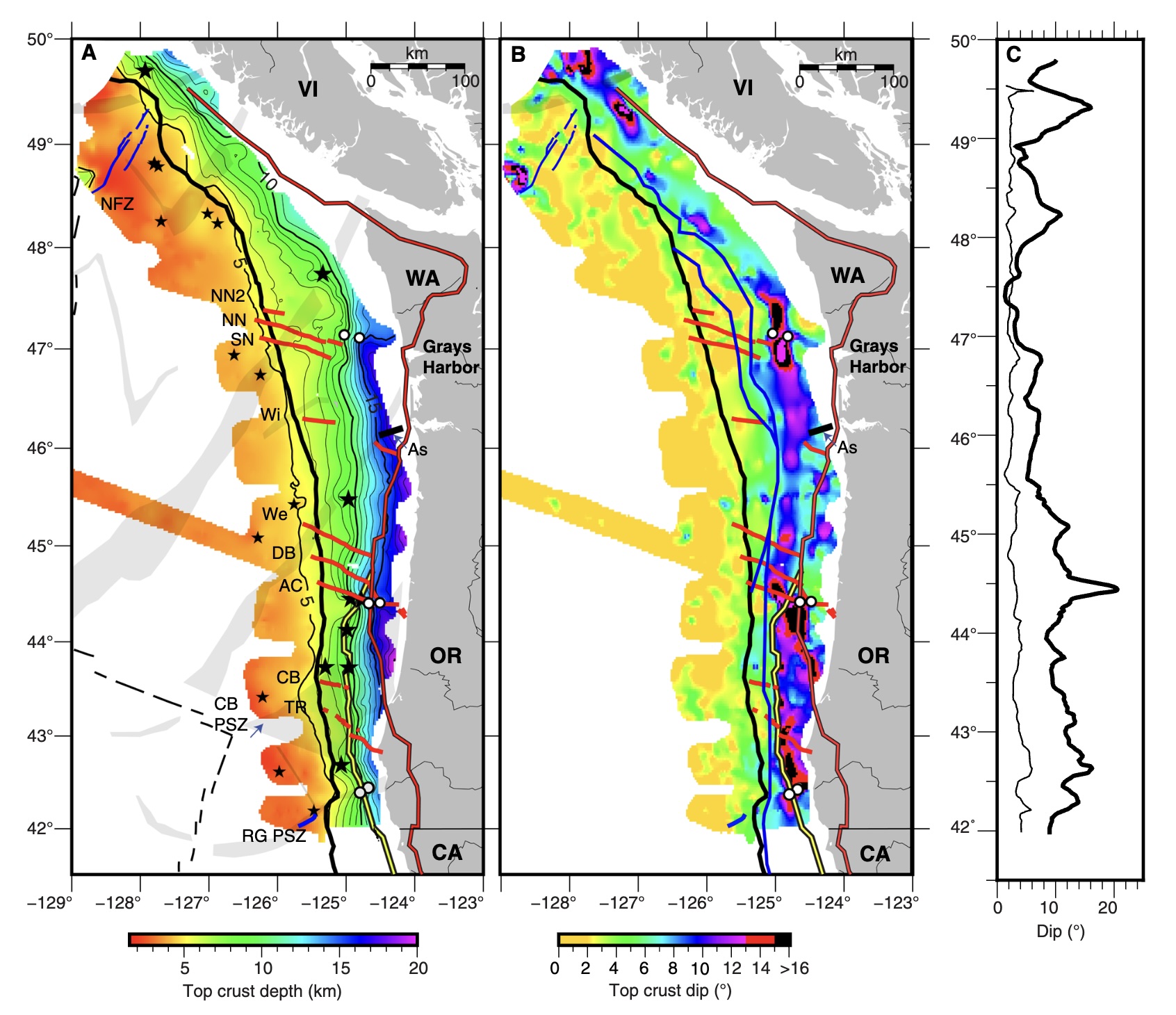
Figure 1:Geometry of top of igneous crust surface along the Cascadia Subduction Zone. (A) Gridded surface showing top Oceanic Crust (tOC) depth derived fromCASie21 and Ridge2trench Pre- Stack depth Migration (PSdM) seismic sections. Plate depth contours in thin black line with every 5 km in bold. Apex of seamounts identi-fied from seismic images indicated with black stars. three pairs of white circles indicate crossing of interpreted faults in lower plate discussed in text. Propagator shearzones (PSZs; gray shading) and plate boundaries (black dashed line) from Fig. 1 are shown to highlight incoming plate tectonic segmentation. (B) Calculated dip of tOCfrom (A). interpreted western edge of wedge backstops from (17) shown including dynamic backstops (blue); static backstops including Siletz-Crescent-Klamath terranes(red with black outline); Franciscan Complex (yellow with black outline). See Materials and Methods for details on gridding and dip calculations. (C) isodistance profiles ofdip of tOC at 20 km seaward and 50 km landward of the deformation front (dF) (thin and bold black lines, respectively).
Summary
The origin of rupture segmentation along subduction zone megathrusts and linkages to the structural evolution of the subduction zone are poorly understood. Here, regional-scale seismic imaging of the Cascadia margin is used to characterize the megathrust spanning ~900 km from Vancouver Island to the California border, across the seismogenic zone to a few tens of kilometers from the coast. Discrete domains in lower plate geometry and sediment underthrusting are identified, not evident in prior regional plate models, which align with changes in lithology and structure of the upper plate and interpreted paleo-rupture patches. Strike-slip faults in the lower plate associated with oblique subduction mark boundaries between regions of distinct lower plate geometry. Their formation may be linked to changes in upper plate structure across long-lived upper plate faults. The Juan de Fuca plate is fragmenting within the seismogenic zone at Cascadia as the young plate bends beneath the heterogeneous upper plate resulting in structural domains that coincide with paleo-rupture segmentation.
Model Information
SUMMARY: Depth to the Top of igneous Oceanic Crust (TOC) and to the interpreted plate boundary/megathrust fault