California Landslide Data Preprocessing#
Overview#
This notebook processes landslide data from california for integration with the Cascadia regional dataset.
Key Processing Steps:#
Load Dataset
Standardization: Add filtering column names and data types with unified schema
Export Processing: Save cleaned data as standardized GeoJSON
Initial Inspection#
import geopandas as gpd
import pandas as pd
import matplotlib.pyplot as plt
import seaborn as sns
gdf = gpd.read_file("../data/California/cgs_DC213.geojson")
len(gdf)
12909
# Show all columns when printing DataFrames
pd.set_option("display.max_columns", None)
pd.set_option("display.width", None)
gdf.head()
| sec_geol_unit_map_symb | SymSize | SHAPE.STArea() | SHAPE.STLength() | OBJECTID | creation_date | revision_date | geom_rev_date | geom_rev_staff | ls_id | ls_master | activity | init_type | subs_type | mvmt_mode | confidence | thickness | dir_mvmt | base_map | map_year | ls_data_source_type | ls_data_source_desc | prim_geol_unit_map_symb | prim_geol_unit_name | sec_geol_unit_name | geol_data_source | strike_az | dip | attitude_type | att_data_source | staff | peer_rev_staff | remarks | data_class | citable_product | mvmt_date_yr | mvmt_date_mon | mvmt_date_day | triggering_event | superseded | citable_product_url | gis_source | created_user | created_date | last_edited_user | last_edited_date | FeatID | display_class | source_layer_id | geometry | |
|---|---|---|---|---|---|---|---|---|---|---|---|---|---|---|---|---|---|---|---|---|---|---|---|---|---|---|---|---|---|---|---|---|---|---|---|---|---|---|---|---|---|---|---|---|---|---|---|---|---|---|
| 0 | None | 2.858618 | 2299.895764 | 268.182677 | 1965 | 1362700800000 | None | None | None | Vent0770 | None | None | None | None | None | None | None | 150.0 | 2015.0 | None | Qsb | None | None | Tan, 2003 | 90.0 | 40.0 | bed | Tan/Dibblee | None | A | CGS Landslide Inventory Map in progress 2015 | None | None | None | None | N | None | G:\CGS\GM_Work\Landslide Inventories\StateLand... | None | NaN | None | NaN | 1965 | 2 | 13 | POLYGON ((-13276650.321 4068567.489, -13276652... | ||||
| 1 | None | 3.883193 | 9061.502229 | 777.839423 | 2611 | 1367366400000 | None | None | None | Vent1418 | None | None | None | None | None | None | None | 120.0 | 2015.0 | None | Qls developed in Tp | None | None | Tan, 2003 | NaN | NaN | None | None | None | A | CGS Landslide Inventory Map in progress 2015 | None | None | None | None | N | None | G:\CGS\GM_Work\Landslide Inventories\StateLand... | None | NaN | None | NaN | 2611 | 2 | 13 | POLYGON ((-13276837.792 4076551.465, -13276826... | ||||
| 2 | None | 5.290792 | 4525.327447 | 285.107144 | 3970 | 1450889472000 | None | None | None | None | None | df | None | None | None | None | 290.0 | None | NaN | IMG | None | None | None | None | None | NaN | NaN | None | None | None | None | None | C | CGS to CDF 92 | None | None | None | None | N | G:\CGS\GM_Work\Landslide Inventories\StateLand... | NROTH | 1.450983e+12 | NROTH | 1.450983e+12 | 3970 | 2 | 13 | POLYGON ((-13571751.348 4448987.266, -13571747... | ||
| 3 | None | 9.967204 | 23680.277869 | 791.939850 | 3971 | 1450889472000 | None | None | None | None | None | rs | None | None | None | None | 100.0 | None | NaN | IMG | None | None | None | None | None | NaN | NaN | None | None | None | None | None | C | CGS to CDF 92 | None | None | None | None | N | G:\CGS\GM_Work\Landslide Inventories\StateLand... | NROTH | 1.450983e+12 | NROTH | 1.450983e+12 | 3971 | 2 | 13 | POLYGON ((-13572747.205 4449035.828, -13572760... | ||
| 4 | None | 4.277160 | 2231.315528 | 173.893848 | 3972 | 1450889472000 | None | None | None | None | None | df | None | None | None | None | 220.0 | None | NaN | IMG | None | None | None | None | None | NaN | NaN | None | None | None | None | None | C | CGS to CDF 92 | None | None | None | None | N | G:\CGS\GM_Work\Landslide Inventories\StateLand... | NROTH | 1.450983e+12 | NROTH | 1.450983e+12 | 3972 | 2 | 13 | POLYGON ((-13572223.032 4449034.498, -13572217... |
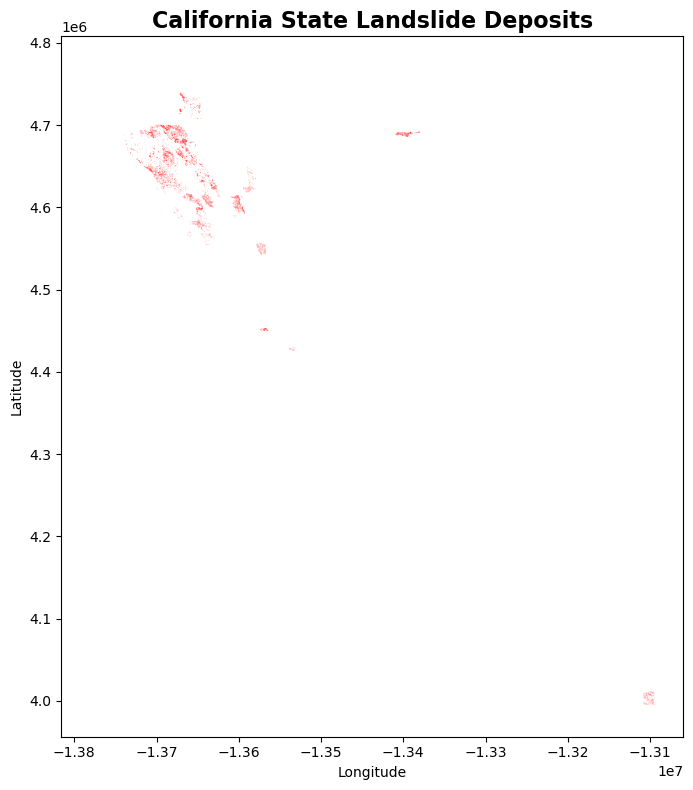
# Simple plot of landslide deposits
fig, ax = plt.subplots(figsize=(12, 8))
gdf.plot(ax=ax, alpha=0.7, color='red', markersize=0.5)
ax.set_title("California State Landslide Deposits", fontsize=16, fontweight='bold')
ax.set_xlabel("Longitude")
ax.set_ylabel("Latitude")
plt.tight_layout()
plt.show()
Analysis#
# Seperating deposits by column types
numerical_cols = gdf.select_dtypes(include=['number']).columns.tolist()

non_numerical_cols = gdf.select_dtypes(exclude=['number']).columns.tolist()
print("Numerical Columns:")
for col in numerical_cols:
    print(f"  - {col}")

print("\nNon-Numerical Columns:")
for col in non_numerical_cols:
    print(f"  - {col}")
Numerical Columns:
  - SymSize
  - SHAPE.STArea()
  - SHAPE.STLength()
  - OBJECTID
  - creation_date
  - dir_mvmt
  - map_year
  - strike_az
  - dip
  - created_date
  - last_edited_date
  - FeatID
  - display_class
  - source_layer_id

Non-Numerical Columns:
  - sec_geol_unit_map_symb
  - revision_date
  - geom_rev_date
  - geom_rev_staff
  - ls_id
  - ls_master
  - activity
  - init_type
  - subs_type
  - mvmt_mode
  - confidence
  - thickness
  - base_map
  - ls_data_source_type
  - ls_data_source_desc
  - prim_geol_unit_map_symb
  - prim_geol_unit_name
  - sec_geol_unit_name
  - geol_data_source
  - attitude_type
  - att_data_source
  - staff
  - peer_rev_staff
  - remarks
  - data_class
  - citable_product
  - mvmt_date_yr
  - mvmt_date_mon
  - mvmt_date_day
  - triggering_event
  - superseded
  - citable_product_url
  - gis_source
  - created_user
  - last_edited_user
  - geometry
New Columns#
Confidence#
We will convert the values into 3 main classes Moderate, High and Low to be more consistent with Washington and Oregon.
Raw Confidence Values#
print("Value Counts for Confidence:")
print(gdf['confidence'].value_counts())
Value Counts for Confidence:
confidence
d    2377
q    1405
p     394
c       3
h       2
o       1
Name: count, dtype: int64
Replacing empty strings with NaN#
# Normalize to H/M/L categories
# Assuming the original codes are single letters: p, d, q
mapping = {
    "p": "High",
    "d": "Medium",
    "q": "Low"
}

# Apply the mapping (case-insensitive)
gdf["filter_CONFIDENCE"] = gdf["confidence"].str.lower().map(mapping).fillna("Unknown")

# Quick check
gdf[["filter_CONFIDENCE", "confidence"]].value_counts()
filter_CONFIDENCE  confidence
Medium             d             2377
Low                q             1405
High               p              394
Unknown            c                3
                   h                2
                   o                1
Name: count, dtype: int64
Type#
Original Type#
type_counts = gdf['init_type'].value_counts()
print("\nValue Counts for Type:")
print(type_counts)
Value Counts for Type:
init_type
df    2171
rs    1717
ef    1696
ss      19
cl      16
q        3
d        1
Name: count, dtype: int64
Extracting Material from Type#
import pandas as pd

# --- 1) Allowed categories (must match your filter lists exactly) ---
KNOWN_MATERIALS = ["Debris", "Earth", "Rock", "Complex", "Water", "Submarine"]
KNOWN_MOVEMENTS = ["Flow", "Complex", "Slide", "Slide-Rotational", "Slide-Translational",
                   "Avalance", "Flood", "Deformation", "Topple", "Spread", "Submarine"]

# --- 2) Look-up tables (seed set; extend as needed for your dataset) ---
# Map mvmt_mode codes -> movement categories (one or more)
MVMT_MODE_MAP = {
    "st": {"Slide", "Slide-Translational"},
    "sr": {"Slide", "Slide-Rotational"},
    "sc": {"Slide", "Complex"},          # compound slide
    "fl": {"Flow"},
    "av": {"Avalance"},                  # keep your category spelling
    "fd": {"Flood"},
    "dp": {"Deformation"},
    "tp": {"Topple"},
    "sp": {"Spread"},
    "sb": {"Submarine"},
}

# Map init/subs codes -> (materials, movement-hints)
# (Use both init_type and subs_type; union them.)
INIT_SUBS_MAP = {
    "df": ({"Debris"}, {"Flow"}),            # debris flow
    "ef": ({"Earth"}, {"Flow"}),             # earth flow
    "rf": ({"Rock"}, {"Topple"}),            # rock fall -> closest: Topple
    "dl": ({"Debris"}, {"Slide"}),           # debris slide
    "el": ({"Earth"}, {"Slide"}),            # earth slide
    "rl": ({"Rock"}, {"Slide"}),             # rock slide
    "dg": ({"Complex"}, {"Deformation"}),    # disrupted ground
    "dn": ({"Debris"}, {"Flow"}),            # debris fan (flow deposit)
    "la": ({"Water", "Debris"}, {"Flow"}),   # lahar (if present)
    "cm": ({"Complex"}, {"Complex"}),        # explicit complex (if present)
    "sb": ({"Submarine"}, {"Submarine"}),    # submarine (if present)
    # add more codes here as you encounter them
}

def _codeset(v):
    if pd.isna(v):
        return set()
    s = str(v).strip().lower()
    # handle comma/semicolon separated combos if they occur
    parts = [p.strip() for p in s.replace(";", ",").split(",") if p.strip()]
    return set(parts) if parts else ({s} if s else set())

def infer_material_movement(row):
    mats, movs = set(), set()

    # mvmt_mode is the strongest movement signal
    for code in _codeset(row.get("mvmt_mode")):
        movs |= MVMT_MODE_MAP.get(code, set())

    # init_type and subs_type inform both material and movement
    for code in _codeset(row.get("init_type")) | _codeset(row.get("subs_type")):
        m2, v2 = INIT_SUBS_MAP.get(code, (set(), set()))
        mats |= m2
        movs |= v2

    # Keep only known categories to avoid typos
    mats = [m for m in KNOWN_MATERIALS if m in mats]
    movs = [m for m in KNOWN_MOVEMENTS if m in movs]

    # Fallbacks: if nothing inferred, pick sensible defaults
    if not mats:
        mats = ["Complex"]
    if not movs:
        # If slide subtype present without generic 'Slide', add it
        # (e.g., Slide-Rotational → also include Slide for your filters)
        movs = ["Slide"]

    # Return as semicolon-separated lists to allow combinations
    return pd.Series({
        "material": "; ".join(mats),
        "movement": "; ".join(movs),
    })

# --- 5) Apply inference ---
gdf[["filter_MATERIAL", "filter_MOVEMENT"]] = gdf.apply(infer_material_movement, axis=1)

# --- 6) Quick QA checks ---
print("Material distribution:")
print(gdf["filter_MATERIAL"].value_counts().head(15), "\n")

print("Movement distribution:")
print(gdf["filter_MOVEMENT"].value_counts().head(15))
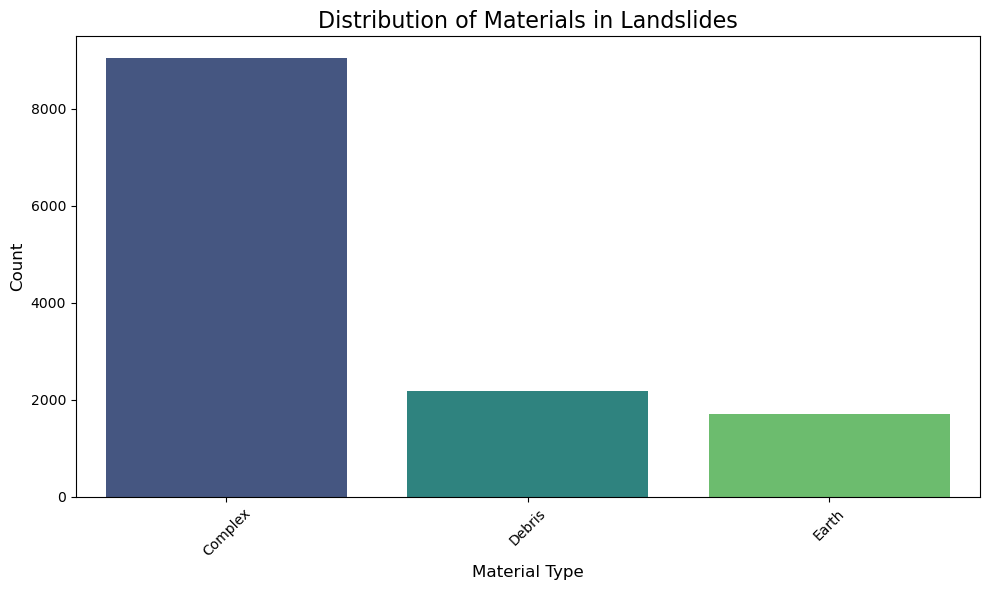
Material distribution:
filter_MATERIAL
Complex    9042
Debris     2171
Earth      1696
Name: count, dtype: int64

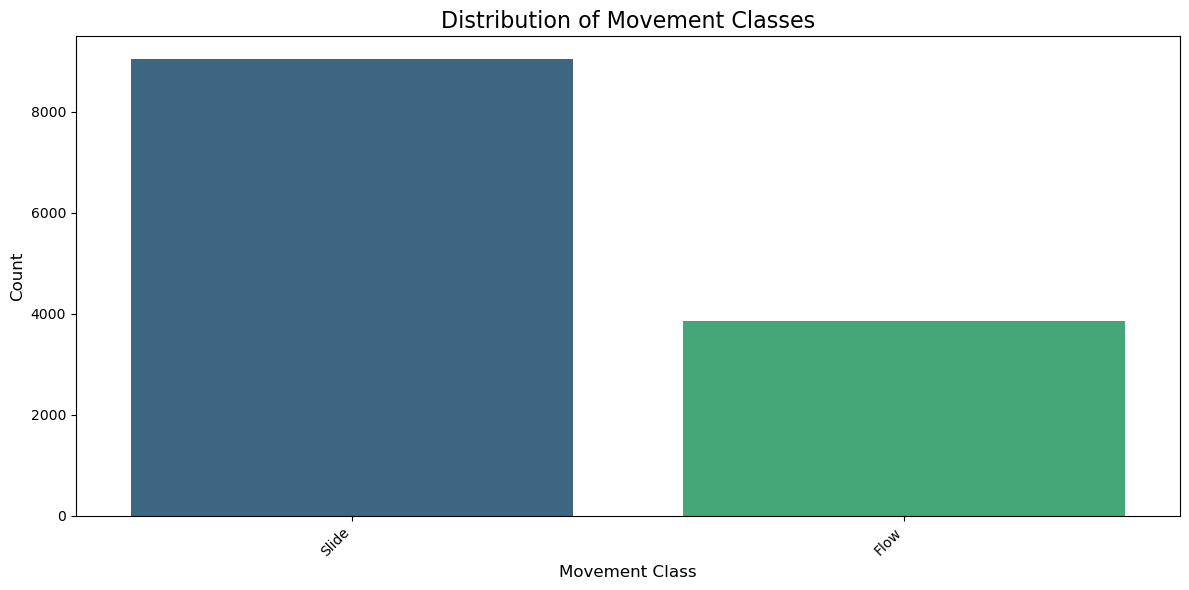
Movement distribution:
filter_MOVEMENT
Slide    9042
Flow     3867
Name: count, dtype: int64
# Plot distribution excluding NaN values
plt.figure(figsize=(10, 6))
non_null_counts = gdf['filter_MATERIAL'].value_counts()
sns.barplot(x=non_null_counts.index, y=non_null_counts.values,
            palette='viridis', hue=non_null_counts.index, legend=False)
plt.title('Distribution of Materials in Landslides', fontsize=16)
plt.xlabel('Material Type', fontsize=12)
plt.ylabel('Count', fontsize=12)
plt.xticks(rotation=45)
plt.tight_layout()
plt.show()
plt.figure(figsize=(12, 6))
non_null_counts = gdf['filter_MOVEMENT'].value_counts()
sns.barplot(x=non_null_counts.index, y=non_null_counts.values,
            palette='viridis', hue=non_null_counts.index, legend=False)
plt.title('Distribution of Movement Classes', fontsize=16)
plt.xlabel('Movement Class', fontsize=12)
plt.ylabel('Count', fontsize=12)
plt.xticks(rotation=45, ha='right')
plt.tight_layout()
plt.show()
gdf['filter_ORIGIN'] = 'CALIFORNIA_DC2'
gdf['filter_DATASET_LINK'] = 'https://maps.conservation.ca.gov/cgs/lsi/app/'
gdf['filter_REFERENCE'] = gdf['att_data_source']
Save into GeoJSON#
gdf.to_file("./processed_geojson/CAL_DC2_landslides_processed.geojson", driver='GeoJSON')
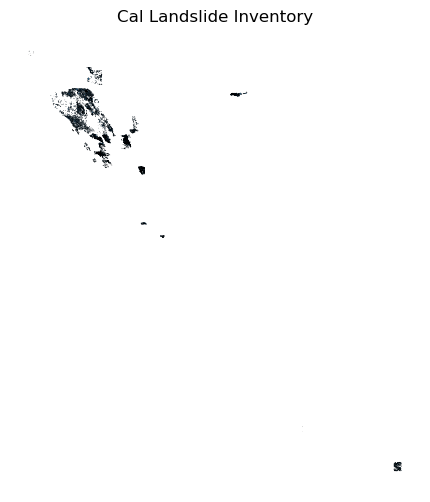
gdf.plot(figsize=(8, 6), edgecolor="k", linewidth=0.2)
plt.title("Cal Landslide Inventory")
plt.axis("off")
plt.show()